
Monitoring humidity in lubrication and hydraulic oils is a simple but powerful way to protect engines and machinery from moisture‑related damage. A humidity sensor provides direct information about the water content in the oil, helping operators understand whether operating and storage conditions keep the fluid within the safe range.
Excess humidity in oil can cause corrosion, reduced film strength, increased oxidation and faster degradation of additives. By regularly measuring humidity and documenting the results, maintenance teams can identify trends, take corrective actions such as oil purification or replacement in time, and avoid costly failures of bearings, gears, pumps and other critical components.
Reliable humidity measurement – protecting machinery through accurate moisture detection
Excessive amounts of water in hydraulic fluids and lubricants can pose a risk to the normal operation of engine components (e.g. reduced performance of the auxiliary diesel). In this respect, continuous monitoring of the water content in oil using the HUMIDITY SENSOR enables efficient real-time tracking of any changes that occur. In addition to laboratory analyses that measure the absolute water content in ppm (parts per million), the HUMIDITY SENSOR STANDARD is designed to measure the relative humidity value. Accordingly, free or dissolved water is determined.
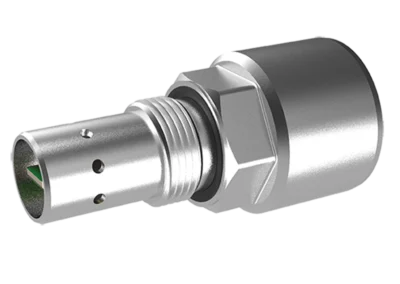
Humidity sensor standard
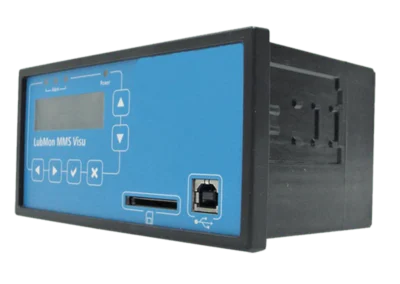
datalogger
Simple function
Technical specification
Datalogger
As soon as the HUMIDITY SENSOR STANDARD is set up, it starts measuring the level of oil saturation with water on a continuous basis. The moisture value obtained is processed on the special DATALOGGER display unit. The concentration of water (in %) is calculated in the range from 0% (no water detected) to 100% (complete saturation/existence of free water).
In contrast to the need to determine the saturation limit of different types of oil (e.g. a comparatively low water absorption capacity of mineral oils or, on the contrary, a relatively high water capacity of ester oils), the sensor technology does not require this value for assessing the water concentration in oil.
With regard to unsaturated ester oils, the use of the HUMIDITY SENSOR is essential. Because measurement methods with portable test devices require the use of a reagent, they are not suitable for unsaturated ester oils due to the reaction that occurs.
When measuring the relative humidity, the actual temperature of the oil influences the dissolution capacity. For example, warm oil can absorb more water than cold oil. Therefore, the relative humidity of the oil increases if no more water is added. On the other hand, hot, relatively dry oil can suddenly contain free water when the ambient temperature drops.
Regardless of the oil type and temperature, the HUMIDITY SENSOR STANDARD provides an accurate real-time measurement of the moisture value and provides immediate information as to whether the parameter is within normal ranges or not.
Due to its immersion depth of only 29 mm, the sensor is ideal for small pipe diameters.
- Measuring range: 0 – 100% (relative humidity)
- Temperature: -20°C to +85°C
- Power supply: 9 – 33 V
- Operating pressure: max. 10 bar
- Protection class: IP 67
The DATALOGGER is part of the MODULAR MONITORING SYSTEM, which is suitable for recording, storing and displaying the data obtained. Although the device has been specially developed for its own sensor system, the DATALOGGER can also be programmed and customised according to the specific characteristics of a particular application.
Technical features
- Ambient conditions Storage:
- Temperature: 0-60°C
- Humidity: 0-95%
- Ambient conditions Operation:
- Temperature: 5-50°C
- Humidity: 0-95%
- Internal data memory: 1000 recordings
- LED display
- Power supply: 9-33 VDC
- Interface: RS-232, analogue 4-20 mA
- SD card up to 4 GB