
Rotating machinery such as pumps, fans, compressors, separators, motors and generators is essential to safe and efficient operation, on board and ashore. Wear, unbalance, misalignment, poor lubrication or electrical faults show up early as changes in vibration, noise, temperature or magnetic field. Condition monitoring measures these parameters continuously or at regular intervals. This shows the actual condition of each machine, so maintenance can be planned before damage leads to unplanned downtime, costly repairs or off-hire time.
Wi-Fi Sensor Technology for Smarter Maintenance
This compact multi-sensor brings professional machinery diagnostics into a single wireless device. In a robust housing made of hard-anodised aluminium, it combines vibration, sound and ultrasound, temperature and magnetic field measurement. Internal signal processing and Wi-Fi communication mean there are no cables to lay. Measurement data go straight to your smartphone, tablet, PC or the cloud.
Detect Faults at an Early Stage
Damaged or poorly lubricated moving parts cause vibration levels to rise. Characteristic patterns in the frequency spectrum show the type of damage and the affected component. Tracking these values over time lets you estimate when a machine is likely to fail, so repairs can be planned for scheduled maintenance rather than forced by a breakdown.
The standard 3D MEMS accelerometer (±16 g, up to 6.4 kHz) detects typical faults such as:
-
Unbalance and eccentricity of rotors
-
Shaft misalignment
-
Looseness and cracks in machine components
-
Damage to gears and belts
-
Damage and fouling on turbines and fans
-
Electrical faults in motors
-
Critical speeds and resonances
The sensitive magnetic field sensor (up to 10 kHz) also helps diagnose motor and generator windings, and it can determine shaft speed for spectrum analysis.
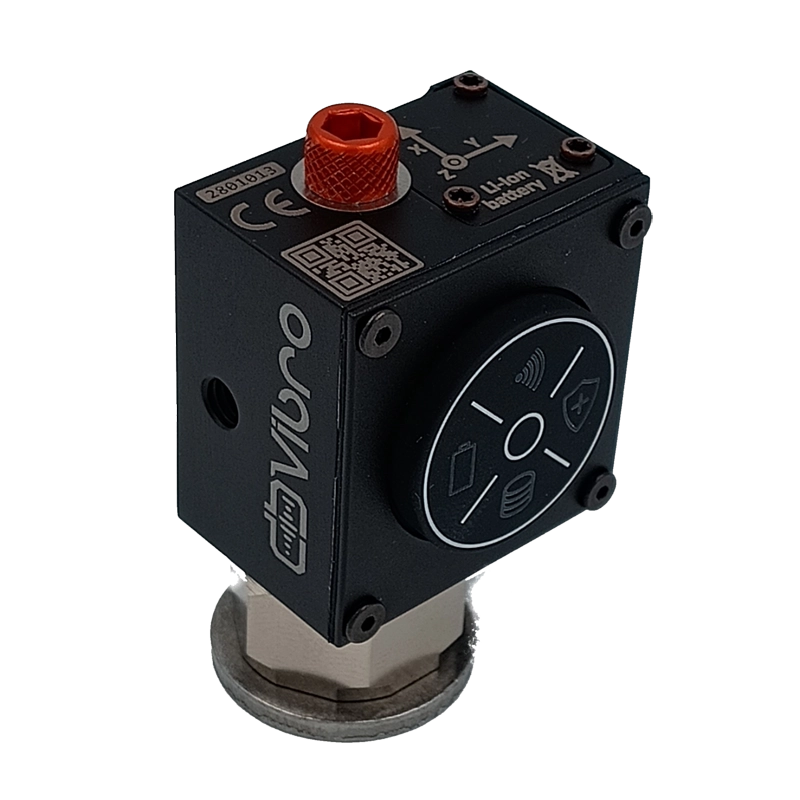
VE 3506
Key features
Operation Models
License options
-
Vibration, sound/ultrasound, temperature (-30 to +110 °C) and magnetic field in one sensor
-
Wi-Fi IEEE 802.11 b/g/n with WPA2 encryption
-
Ethernet 10/100Base-TX with PoE and Modbus/TCP
-
IP67 protection, dust-tight and resistant to immersion
-
Compact: 40 x 42 x 27 mm, only 110 g
-
Rechargeable Li-Ion battery with built-in charger and smart power management
-
Simple mounting with an M6 screw or magnetic base
Mobile inspection rounds:
Use a smartphone or tablet as the user interface. Magnetic bases at each measuring point keep the sensor firmly attached and correctly aligned. You identify each point by QR code or NFC tag. The software chooses the right settings automatically, and raw signals are stored, so you can run further analyses later. The rechargeable Li-Ion battery lasts about 8 hours on average.
Permanent monitoring:
For machines that run under changing conditions or show faults only now and then, the sensor can stay in place for long periods. It wakes at set intervals, records data and sends the results to the server automatically when a network is available. Alarms can also be sent by SMS or e-mail.
Seamless System Integration
Besides Wi-Fi, which can be switched off, the sensor has a wired Ethernet interface with Power over Ethernet (PoE) and Modbus/TCP. Calculated parameters and alarms go directly to automation, alarm and monitoring systems, where they can be shown on overview screens. For machines with variable speed or cyclic operation, a digital input lets you connect a speed or position sensor to trigger and synchronise measurements.
Expandable by Licence
You can unlock more functions through licences as your needs grow:
-
High-precision vibration: an additional low-noise Z-axis sensor with ±50 g, up to 15 kHz and 24-bit signal processing finds bearing and gear damage even earlier.
-
Sound and ultrasound: a built-in acoustic transducer (15 Hz to 51.2 kHz) for noise measurement, lubrication monitoring of bearings, leak detection in compressed-air and gas systems, cavitation assessment and detection of partial discharges.
-
Data recording: 8 GB of internal memory for unattended, interval-based recording of time waveforms.
-
Autonomous monitoring: the sensor calculates the diagnostic parameters itself, switches a built-in relay when alarm thresholds are exceeded and sends the data to the server right away.